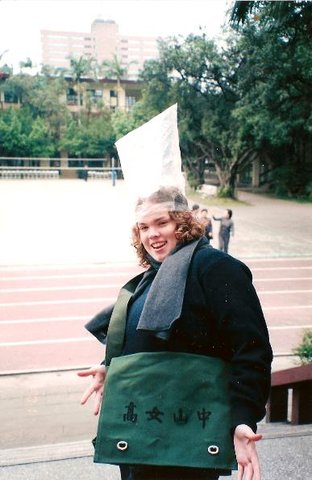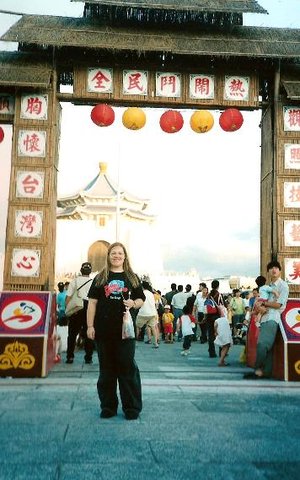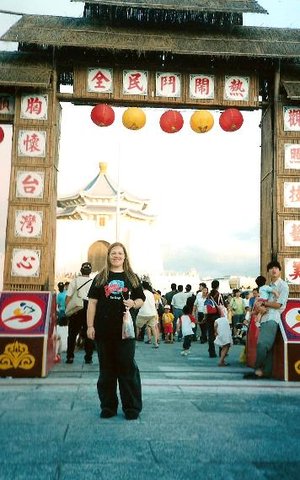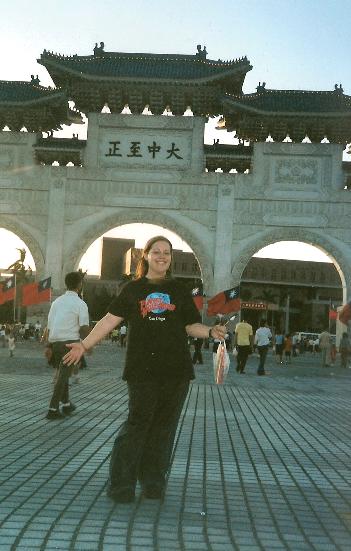
It wasn’t long before language cram school ended and we were all off to high school. Jessica, Emilie, Hannah and I were off to 中正高中, a mixed gender school. Beth, Clelia, Claire, Sylvie and Muriel (correct me if I’m wrong, Beth!) went to 高女山中, an all-girl school. Lucas also went to my school, and there I met Raul and Jorge, two brothers from Paraguay whose parents were diplomats. Their other brother, Eduardo, went to a different school. Along with Lucas, these three brothers pushed us to new levels of exchange student monkeyshines because they had the most important thing of all: diplomatic immunity. They did whatever they wanted, whenever they wanted because it didn’t matter. It wasn’t long before all of us started acting as if we had diplomatic immunity as well. School uniforms were the traditional japanese-hyper-fetished pleated skirt with a button-up shirt on top for regular days, and windpants and polo shirt on gym class days. Additionally, each school had their own bag with the school name printed on it. 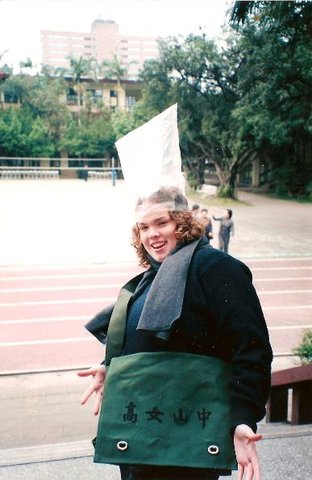 Wearing skirts to school became particularly awesome on monsoon days, when sheets of rain would hit your legs and tremendous gusts of wind would attempt to blow your skirt up. Add this to the gusts of wind coming from the MRT (subway system) and many of us oftentimes felt like Marilyn Monroe, battling against showing our dingy underwear to the world. Taiwan is tropical, but during the winter with all of the humidity in the air, it doesn’t matter what the thermometer says–it’s FREEZING. Those days the wind just bites into you, and skirts are woeful protection against it. Some schools compensated for this by having school sweaters. My school did not.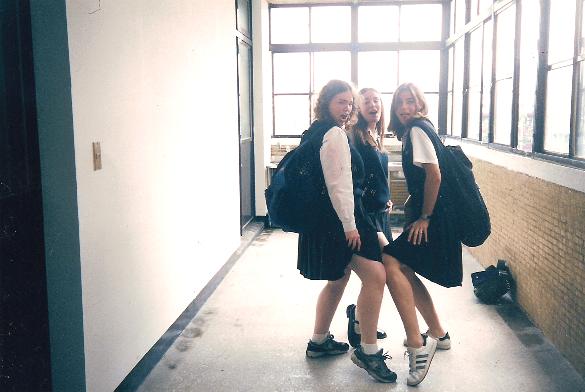
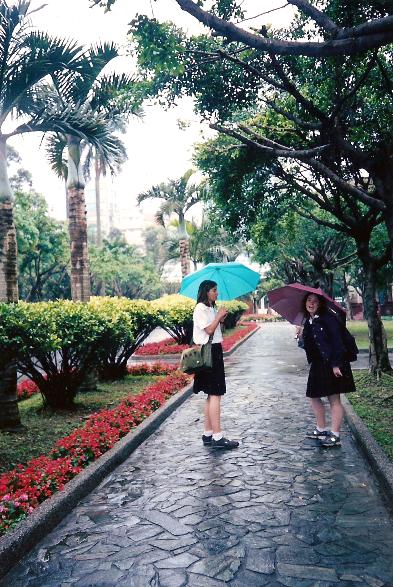 An umbrella was an IMPORTANT THING to remember every day. In Seattle, we pick out tourists by who’s carrying an umbrella. In Taiwan, they pick out idiots by who’s NOT carrying one. I had at least 10 different umbrellas over the course of the year–you’d lose them, or someone would take yours when you leave it outside of a shop, or it’d simply be destroyed by the wind. They sell umbrellas in such massive quantities there that they run about $3 US. Or, if you happened to be out of money and caught in a freak storm, you’d share umbrella karma by taking someone ELSE’S umbrella from outside a store after yours has been taken. That’s just the way things went. Umbrellas were like community property. I lived fairly far away from my school; over an hour each way, counting walking and buses and transfers. I was more fortunate than students like Maria, however, who had to travel by train out of the mountains to get to a subway station and then go to school–she traveled nearly two hours each way. They don’t do school districts in Taiwan; each student is tested extensively and placed in a school according to their learning ability/aptitude. So where you lived had nothing to do with where you would be going to school. The students who went to the best high schools were the ones most likely to be admitted to university. All exchange students were placed in the highest-ranked schools in order to discourage us from associating with riffraff.
 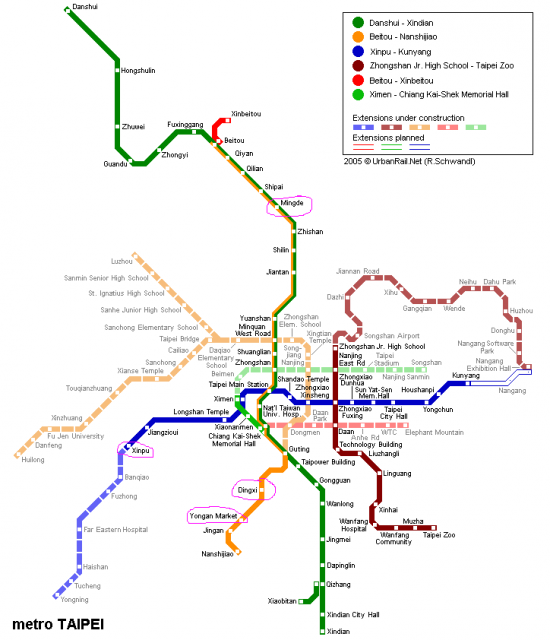 My first host family lived nearest to Dingxi, my second was at Yongan Market, my third at Xinpu, and my school was at Mingde. Students in Taiwan work very very hard at their studies; many of them spend six to eight more hours in a cram school after their regular school day is over. This made it very difficult to get to know any of the students; they simply didn’t have time to waste with us. The after-school job is virtually unheard of in Taiwan; extra time is to be spent studying. I don’t know how else to explain this without being deeply offensive, but it keeps them immature longer because they don’t have any life experience outside of school–being with 17 year olds at 中正高中 was like being with 12 or 13 year olds in the states. That also made it really hard to relate to them. Much in the same way that people from the US make generalizations about other countries–“Taiwan is all sweatshops and child labor,” “France is full of stinky, rude, and cowardly people,” the Taiwanese make assumptions about us based on what they see in movies. Therefore, people wanted to know where I kept my gun. Joyce and ‘Sweetie’ brought Beth and I chocolate because they ‘heard we were American’. People assumed that in America, we see gang fights on a regular basis, and when shit blows up, that’s just normal. Hell, I might see three different cars blow up on my way to school and not think twice about it. My first day at school, my classmates surrounded me and started PETTING MY HAIR. All I heard were coos of ‘blond! blond!’ coming from all around me. I felt like a scared baby llama at a petting zoo being poked and prodded by preschoolers. Emilie got the same treatment in her classroom, except they tried to poke her eyes as well. We were both majorly freaked out by this development. Jessica got off fairly easily, being dark-skinned, with dark hair and eyes, and I’m not sure how Hannah fared because she stopped hanging out with us immediately after school started. We were already used to being novelties, but this was a step above and beyond what we’d experienced in the past (people talking about us on the MRT, people pointing us out when we walked by (my Chinese got better as the year went on, but for all I know at the beginning they could’ve been saying “LOOK OUT SHE’S GOT A GUN!”)). After lunch, the notes started landing on my desk.
 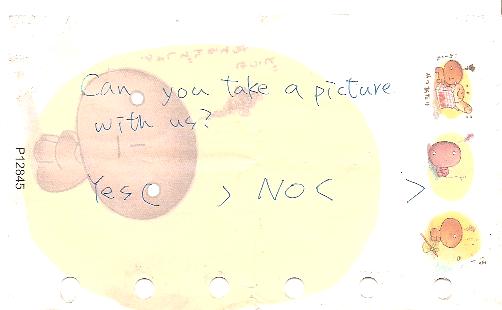 Of course you let them take their picture with you, or you fill out their hello kitty contacts book with your vital info (height, weight, blood type, phone number, favorite color, etc) to be nice, but it really has the tendency to make one feel less like a celebrity and more like a monkey who can read and write that’s escaped from the zoo and making the rounds in a uniform. More about schools later, I think covering the first day was enough for today. A starter for tomorrow’s topic, which I believe will be about food (I’m not always sure what I’m going to write about until I’ve started writing it):
 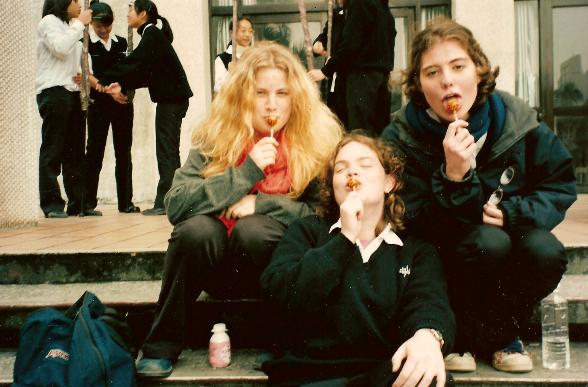 Muriel, Beth, and Sylvie pose outside their school with suckers….butter flavored ones. Mmmmmmmmm butter.
Taiwan Part Eight: School Daze